Approach in Understanding Our Economy
replace technically demanding tools without losing the economics
Annika Johnson · Anastasia Papadopoulou
May 29, 2026 · Las Vegas
The one-course problem
"If students only take one economics course, what should they learn?"
- Most students take exactly one economics course — a literacy course, not a gateway to the major
- Standard principles courses are designed for future economists: tools that build on each other over years of study
- The literacy-targeted approach asks: what do citizens, workers, and voters actually need to reason about the economy?
- Understanding Our Economy (UOE) is our attempt to answer that question
Our answer: three interconnected moves
Language choices
Lower barriers, reflect conceptual commitments. No "Pareto," no "Nash," no "indifference." Plain English that doesn't smuggle assumptions.
Pedagogical tools
Familiar representations for unfamiliar ideas. Game trees, heatmaps, and matching replace indifference curves, minimax, and labor S&D.
Content choices
Institutions, matching, and discrimination at the core — not optional extensions. The economy students actually live in.
Six principles run through all 18 chapters as a red thread: Interdependence · Doing the best you can · Trade-offs and opportunity costs · Mutual gains and conflicts · Individual and societal interests · Rules of the game
Teaching principles inductively
Standard approach
- Principles stated upfront — "ten principles of economics" (Mankiw), "first principles" (Krugman & Wells)
- Students encounter them before they have the economics to appreciate them
- Risk: principles feel like a list to memorize, not a framework for reasoning about the world
UOE approach
- Real-world story / data → theory → principle
- The principle is revealed after the economics — as a label for what students have just worked through
- Reinforced at the end of every chapter in the "Seeing the principles in action" table
The inductive sequence runs through all 18 chapters: students first encounter the problem in a real context, then see which principle it instantiates.
A deliberate lexicon
Language choices are not simplifications — they reflect substantive pedagogical and theoretical commitments. Jargon creates unnecessary barriers for the 85% of students who will not take another economics course.
Dropped — and why
UOE term
Retained — and why
Standard terms are always noted in sidenotes — students who continue in economics can bridge the vocabulary.
What is UOE?
- 18 chapters, free and open-access
- Built on The Economy 2.0 (CORE), adapted for North American intro courses
- Targets 2-year colleges, state universities, and non-major literacy courses
- Accepted in California Community College system
- Piloted at Oakton College, Occidental College, and partner institutions
Today's talk: three case studies showing how the literacy-targeted approach shaped specific pedagogical choices
Before Payoff Matrices
Chapter 1: Kellogg, Idaho — the opening question
Children in Kellogg, Idaho were getting sick. A mining company (Bunker) and local workers faced an environmental conflict.
Two players. Two choices. Real consequences. And the outcome depends on what each player expects the other to do.
Why this story works
- Students immediately identify the players
- No abstraction required at the start
- Outcomes are concrete (health, livelihoods)
- Institutional change comes naturally in Ch. 2
Building the game tree — step by step
Click Next step or press Space to advance · Use ← → to change slides
Chapter 2: Worker becomes mayor — changing the rules
The same economic situation. Different institutions. Different outcome.
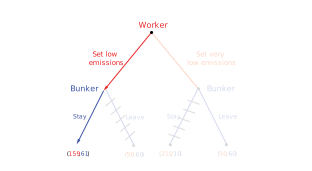
Chapter 1 outcome
- Bunker moves first
- Sets high emissions
- Worker has no choice but to stay
- Payoffs: 169, 51
Chapter 2 outcome
- Worker moves first (as mayor)
- Sets low emissions
- Bunker still stays (profitable)
- Payoffs: 159, 61
First-mover advantage = power. Changing the rules changes the outcome — without changing the payoffs.
Why sequential games first?
Standard approach
- Prisoners' dilemma payoff matrix
- Abstract players, abstract payoffs
- Dominant strategy via cell comparison
- Simultaneous — no narrative sequence
- Simultaneous games appear in UOE Ch. 6
UOE approach
- Game tree with real players, real story
- Sequential — mirrors how people actually think
- "If I do X, they might respond with Y…"
- Solved by common sense (no terminology needed)
- Formal equilibrium concepts come much later
Whether playing Fortnite, navigating a job negotiation, or talking with a friend — people naturally think in sequences. The matrix form is the exception, not the rule, in daily life.
Spot You Can Reach
Why heatmaps? Students already know them
Indifference curves ask a lot
- Require holding two ideas at once: a preference ordering and the mathematical property of indifference
- For the 95% of students who will never take another economics course, is the cognitive investment justified?
- Risk: students learn the curve-drawing mechanics without grasping what the consumer is actually doing
- UOE omits indifference curves entirely — they appear nowhere in the textbook
Heatmaps are already in students' heads
- Weather maps, gaming heat zones, real-estate price maps, sports analytics
- Warm = good, cool = bad — intuitive without instruction
- The constrained maximum is simply the warmest spot you can reach
- Students reason at the margin before they know the word "marginal"
Same insight, different tool: do the best you can within your means
MB = MC: the companion decision rule
UOE retains marginal analysis — but introduces it with step functions, not calculus. Karim (Ch. 6) chooses how many hours to work for Google: each extra hour brings a payment (MB) and an opportunity cost (MC).
- Work more when pay > opportunity cost (point A)
- Work less when pay < opportunity cost (point B)
- Stop at E, where MB = MC
The heatmap and MB = MC are two lenses on the same decision — the heatmap shows the full landscape; MB = MC traces the optimal path along the constraint. Both avoid calculus; both build the same intuition.
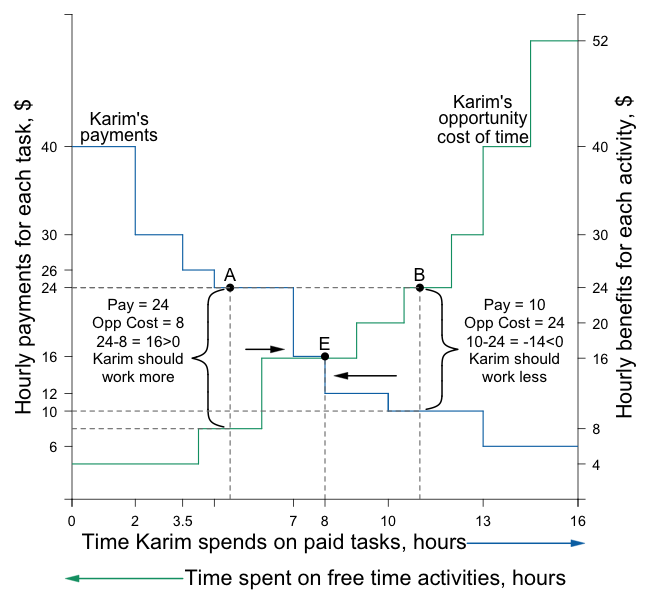
MB and MC: the companion tool
Chapters 7–8 introduce marginal benefit and marginal cost before the heatmap, using work-hours data as the motivating context.
Decision rule: do more if MB > MC · stop when MB = MC
MR and MC curves arrive after the heatmap — not as new ideas, but as a compact summary of something students have already worked through intuitively.
Two tools, one insight
- MB/MC — the rule for incremental decisions: is the next unit worth it?
- Heatmap — the full preference landscape: where is the warmest point you can reach?
- Together they replace indifference curves and calculus-based optimization — delivering the same core insight without either
- Parallel terminology across consumer and firm chapters aids transfer: students encounter MB/MC first for a worker, then a consumer, then a firm
Annika finds the warmest bundle she can afford
No indifference curves required — Chapter 8
☑ Tick Add budget constraint · Drag the white dot from K toward H — watch it get warmer · ☑ Tick Show navigation points to see the path to the warmest affordable bundle
CORE Brewing Co. finds the warmest feasible price and quantity
The same hot-and-cold logic — now for a firm's profit · Chapter 12
☑ Tick Add demand curve · Drag the white dot to find the warmest point · ☑ Tick Show MR & MC to confirm · ☑ Tick Show reference points for K, H, J, I
The heatmap principle: same tool, two decisions
Consumer choice — Ch. 8
- Axes: ice cream scoops × burritos
- Color shows utility at every bundle
- Constraint: budget line
- Annika finds the warmest bundle she can afford
- Formerly: indifference curves + MRS = price ratio
Firm pricing — Ch. 12
- Axes: quantity × price
- Color shows profit at every (Q, P) pair
- Constraint: demand curve
- CORE finds the warmest point on the demand curve
- We also use MR = MC, mirroring MB = MC
Both problems are constrained optimization — find the warmest spot you can reach. The heatmap makes that structure visible without calculus, without indifference curves, and without memorized rules.
Supply and Demand
Why not start with a labor supply-and-demand model?
Supply-and-demand labor
- Workers and employers "glean" the equilibrium wage
- Can only explain unemployment via ad hoc assumptions
- Struggles to explain persistent discrimination
- Abstracts away from the actual hiring process
- Samuelson (1948): issued an "important warning" — but provided no alternative
Matching model (UOE)
- Search and hiring process is at the center
- Naturally explains unemployment and churn
- Extends to discrimination, norms, and social networks
- Resonates with students' own labor market experience
- Prepares students for intermediate macro (Diamond-Mortensen-Pissarides)
The basic matching model
Chapter 10: labor market flows through the career of one fictional worker
Workers (blue) and vacancies (teal ring) move between employment, job search, and inactivity · ⏸ Pause to discuss any step · Type a question in the bar below the animation for a live AI response
Extending the model: discrimination in hiring
The matching framework explains persistence in a way S&D cannot
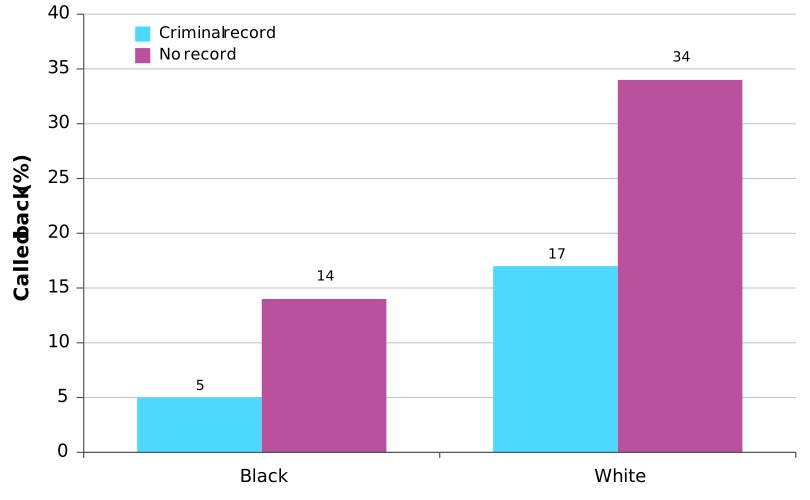
- Start with data: Bertrand & Mullainathan (2004) and Pager (2003) audit studies — students see that discrimination exists
- The matching model explains why it persists: search frictions amplify the salience of biases at each hiring step
- A feedback cycle: discrimination → lower wages → reinforced stereotypes → more discrimination
- Supply-and-demand predicts discrimination should be competed away — the matching model does not
This is material students genuinely care about — and the matching model is the right tool for it
Social norms, networks, and vicious circles
Two more mechanisms the matching model can capture — but S&D cannot
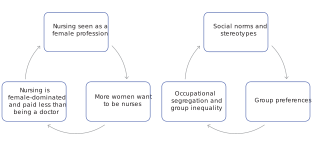
Social norms → gender gaps
If nursing is socially coded as female, more women enter it, which reinforces the norm, which shapes preferences of the next generation…
Social networks → intergenerational inequality
Residential segregation + network-based hiring = workers from low-income neighborhoods have fewer connections to good jobs → their children inherit the disadvantage.
North American community colleges — Eric's experience
- Piloted Ch. 10–11 first, replacing TE 2.0's labor discipline unit — noticeable improvement in understanding and engagement
- Students asking better questions, answering more quiz items correctly, relating material to their lives
- Full UOE pilot in 2025–26: students remarked more often that the text gave them tools to think about their own economic lives
- Chapter 1 particularly effective: immediately engaged students with a relatable problem and complicated simple narratives
California Community College system: CORE Econ's texts are now an accepted choice following the Common Course Numbering review
UOE can be used as a partial replacement (swap specific units from TE 2.0 or a traditional text) or as a full adoption
What makes the approach literacy-targeted?
Each alternative tool was chosen against three criteria:
- Everyday familiarity — heatmaps are in gaming and weather apps; matching is what students experience when job-hunting; sequential reasoning is how people actually think about decisions
- Cognitively accessible without advanced mathematics — none of the alternatives require calculus or formal game theory; students who struggle with math can still reason economically
- Capable of extension to nuanced applications — game trees extend to democracy and power; heatmaps extend to the firm's pricing problem; matching extends to discrimination and social networks
This mirrors Cohen's argument: the LT approach is about depth — applying core concepts to real situations — not breadth, which is exposure to many concepts.
UOE and the CORE family
Shared commitments
- Real-world, empirical grounding
- Institutional analysis
- Problems students care about: inequality, environment, work
- Problem-first pedagogy
Where UOE departs from TE 2.0
- Language: no Pareto, no Nash, no isoprofit
- Tools: heatmaps instead of indifference curves; no isoprofit curves
- Sequencing: sequential games before simultaneous; matching before S&D labor
- Targeting: North American institutional context, community colleges
The Birdi & Spielmann chapter (this volume) and our chapter together illustrate the diversity of approaches within the CORE family — united by principles, differentiated by audience.
The enCOREage community
- Instructors developing and piloting UOE: Katie Baird, Solina Lindahl, Gabriel Martinez, Eric Bottorff, Mary Lopez, and others
- Feedback from pilots has refined figures, examples, and the 'Everyday Economics' sidenotes
- 'Economists in Action' videos in development — connecting chapter material to practitioners
- 'Seeing the principles in action' table links every chapter to the six principles
Free and open access — critical for under-resourced institutions. No access codes, no paywalls, no editions.
Want to pilot UOE? We are actively seeking instructors who want to adopt or adapt UOE in their courses.
Sign up to pilot UOE
Scan to fill out a short sign-up form — we'll be in touch
Conclusion
Understanding Our Economy is one answer to the question Avi Cohen poses: if students only take one economics course, what should they learn?
- Game trees — strategic thinking through narrative; sequential before simultaneous; institutions change outcomes
- Heatmaps — constrained optimization through visual intuition; marginal thinking without the name; MR = MC as summary, not starting point
- Matching markets — labor through the lens students actually experience; discrimination and persistence explained, not explained away
The literacy-targeted approach is not about simplifying economics — it is about choosing tools that deliver the economic insight to the students who need it most.
Annika Johnson · Anastasia Papadopoulou
Live textbook
Textbook: core-understanding-our-economy.netlify.app
These slides: simondhalliday.com
Pilot UOE: Reach out to any of us — we'd love to expand the enCOREage network
Backup Slides
For use during discussion — navigate with ← → keys
The six UOE principles
Interdependence
Your best choice depends on what you expect others to do.
Doing the best you can
People optimize subject to constraints — and so do firms.
Trade-offs and opportunity costs
Any gains from a chosen action come at the cost of the best alternative foregone.
Mutual gains and conflicts
Exchange creates a surplus for all — and a conflict over how that surplus is divided.
Individual & societal interests
Individual optimization does not necessarily produce the best outcomes for society or the environment.
Rules of the game
Institutions and norms shape what players can do — and who benefits.
California Community Colleges: curriculum impact
In 2024, the enCOREage team was invited to provide feedback on the Common Course Numbering (CNN) template for economics — the standard that governs transfer from CC to UC and CSU systems.
- Game theory added to microeconomics content list
- Externalities and public goods added
- Several producer theory topics streamlined
- Course description revised to explicitly mention inequality, labor markets, and government policies
- CORE Econ's texts added to the list of accepted representative textbooks
Revised description: "An introductory course using microeconomic models to understand individual decisions by consumers and firms, market outcomes including market failure, elasticity, market structures, labor markets, inequality, and the impact of government policies."
UOE: chapter structure overview
Microeconomics core
- Ch. 1–2: Game trees, cooperation, conflict, institutions
- Ch. 3: History, inequality, planetary limits
- Ch. 4: Innovation and technology
- Ch. 7–9: Consumer decisions, MB/MC, heatmaps
- Ch. 10–11: Matching markets, effort, wages
- Ch. 12–13: Firm pricing, market power, heatmaps
Extensions and macro
- Ch. 5–6: Markets, externalities, simultaneous games
- Ch. 14–15: Public goods, government policy
- Ch. 16–18: Income, wealth, credit, and the future of our economy
Simultaneous games appear in Ch. 6 — after 5 chapters of sequential reasoning experience
Chapter 11: Effort, wages, and the labor discipline model
Chapter 11 builds on the matching model to examine what happens once a match is made — how employers elicit effort and how wages are determined.
TE 2.0 approach
- Isoprofit curves and reservation wage curve
- Full labor discipline model graphically
- Worker cooperative discussion
- Ownership/control separation theory
UOE approach
- Pared-down labor discipline model
- No isoprofit curves — cost of job loss as the key concept
- Worker cooperatives in Everyday Economics only
- Separation of ownership/control as optional extension
Each element removed from TE 2.0 was removed for a specific reason — length, cognitive load, or relevance to the one-course student
Live textbook — Understanding Our Economy
↗ Open in new tabThe live site cannot be embedded — open it directly:
core-understanding-our-economy.netlify.app ↗Free & open-access · 18 chapters · Accepted in California Community College system
What this looks like in the classroom
- Step-by-step online figures — trees are revealed one node at a time; students trace reasoning rather than confronting a complete diagram
- "Everyday Economics" sidenotes — empirical examples (climate negotiations, fishing rights, workplace bargaining) connect abstract trees to real events
- No formal terminology at first — backward induction is a way of doing the best you can, working back from consequences; Nash equilibrium (which we also call best-response equilibrium) is not introduced until Chapter 6
- "Seeing the principles in action" table — end of chapter explicitly maps what students just did onto Principles 1 and 6
- Pilot feedback — students at Occidental College asked better questions and engaged more deeply than in previous iterations using standard texts
Students can ask questions — live AI responses
The animation includes a student Q&A bar. Questions get two kinds of responses:
- Pattern-matched questions — a pre-scripted animation plays and a narrated response appears in a persistent overlay. Instant, reliable, works offline
- Open questions — sent to Claude (Haiku) as a labor economics teaching assistant. Returns a 1–2 sentence answer in plain language and optionally triggers a matching animation
- Graceful fallback: "I don't know — ask your instructor!" if no API key is present
The response text stays visible in a persistent overlay throughout the animation — so students can read the answer while watching the model move
Try these questions
"What is the unemployment rate?"
"What happens if Maya wants to come back?"
"Why are there still vacancies if there are unemployed workers?"
"What happens to me when I graduate?"
International and non-traditional contexts
Foundation & access programmes
Bridge between high school and university, often for returning students or those studying in a second language. Plain-language approach and six principles scaffold literacy-building.
'One course in econ' — business degrees
Single compulsory economics module in MBA or professional programmes. Case study approach (e.g., heatmaps for profit max) stimulates debate without mathematical obfuscation.
A-level & IB extension
Extended Project Qualification (UK) and IB Extended Essay. UOE chapters as stimulus material — e.g., pairing Ch. 11 on wages with Piketty's Jane Austen discussion.
Free and open-access: a critical feature for adoption in under-resourced institutions and populations worldwide